

About OpsEdge
An operator's approach to supply chain and operations
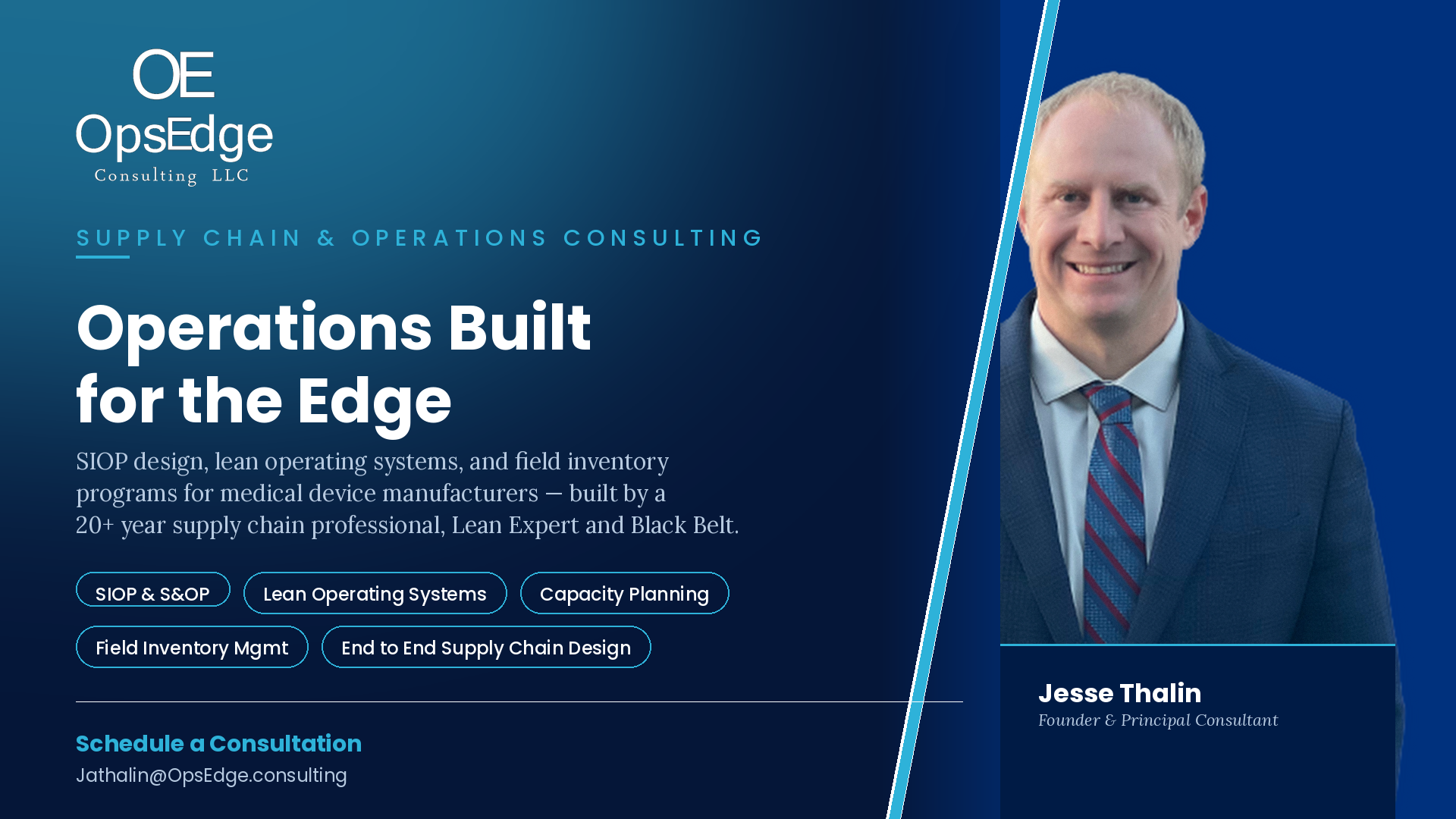
OpsEdge Consulting was founded by Jesse Thalin, a supply chain transformation leader with 20+ years driving operational results inside two Fortune 500 organizations before taking that experience independent. Jesse spent 17 years earning 11 promotions across Honeywell and Medtronic, followed by 2.5 years working private-equity-backed operating partner engagements — before founding OpsEdge to bring that same hands-on rigor directly to clients who need it most.
Jesse is a Lean Six Sigma Master Blackbelt and holds an MBA with an emphasis in quantitative management, but the work itself is what defines OpsEdge: designing and deploying the operating systems, planning processes, and inventory strategies that let manufacturing and commercial organizations run leaner, plan smarter, and scale without losing control of working capital.
OpsEdge exists for one reason — most consulting engagements hand a client a deck. OpsEdge stays in the business long enough to help build the muscle to run it.
OpsEdge Core Services
1. SIOP / S&OP Design & Maturity Assessment
Diagnose where your sales, inventory, and operations planning process actually stands today, then build the phased roadmap to close the gap. Includes current-state maturity assessment, process design, meeting cadence and governance structure, and a phased implementation plan tied to measurable milestones.
Best for: organizations running informal or fragmented planning cycles that need a defensible, repeatable process.
2. End-to-End Supply Chain Design
A full assessment of the supply chain from supplier through customer — inventory strategy, planning processes, organizational structure, and manufacturing footprint — resulting in a prioritized transformation roadmap.
Best for: companies planning a major growth phase, restructuring, or post-acquisition integration.
3. Lean Operating System Deployment
Design and deployment of a lean operating system (TPS/HOS-based) tailored to your actual production or commercial environment — not a generic template. Includes tiered daily management, KPI cascades, A3/Kaizen problem-solving structures, and leader standard work.
Best for: manufacturing or commercial operations teams that need a durable operating rhythm, not a one-time workshop.
4. Capacity Planning & Modeling
Scenario-based capacity models that give operations and commercial leadership a shared, defensible view of what's achievable — across single facilities or a multi-plant network. Built to support both day-to-day production planning and longer-range investment decisions.
Best for: manufacturers facing growth, new product launches, or facility investment decisions who need clarity before committing capital.
5. Field Inventory & Consignment Management
End-to-end design of field inventory and consignment programs — including performance metrics, shrink controls, cycle counting, and outsourced/3rd-party distributor management — for organizations managing inventory across a distributed field sales or service network.
Best for: medical device and field-service organizations managing consigned inventory across hospitals, clinics, or distributor networks.
6. Organizational Design
Right-sizing and structuring commercial, customer care, and operations teams around the work that actually needs to get done — with clear role definition, span-of-control analysis, and a transition plan for standing up the new structure.
Best for: organizations that have outgrown their current structure or are integrating teams after an acquisition or restructuring.
7. Customer Care & Commercial Operations Overhaul
Process redesign for customer service and commercial operations teams — including SOPs, cross-training matrices, and job aids built directly from process mapping with your team.
Best for: service organizations facing scaling pain, inconsistent processes, or key-person dependency risk.
8. External Manufacturing Evaluation
Make-vs-buy and outsourced manufacturing assessments grounded in real cost, capacity, and quality data — helping leadership make confident sourcing and footprint decisions.
Best for: manufacturers evaluating whether to insource, outsource, or dual-source production.